The Glacier
Issue Four
Winter 2025
Lessons in Grief
In whatever they are doing, they have dug up
the neighbor’s magnolia tree. It’s been nearly
a week with it lying on its side, leaves yellowing.
Every midday I pass with the dog and grieve
a little for the brief clamorous white blossoms.
But I don’t think I know how to effectively mourn.
In the show’s third season, the one tells the other
not to push it away, or something like that, and
I think, sure, right. But what about you?
Across the street, another neighbor’s stone wall
is crumbling. There seem to be more shards
every morning on the walk, as if the ground is
furtively sloughing off the rock in the night.
Someone has gathered and piled some of them
to resemble what I’ve seen on shores, though
these edges are jagged and sharp. No water
has smoothed them, ever. It’s a tangible sign
of decline and, at some point, something will have
to be done, but I’m not saddened in the way
I am about the tree. When Jason was last over
he mentioned transplanting a Japanese lilac
Lyon hadn’t wanted and was going to let die,
and how lovely it was in his backyard, near
the lot line, and I now think I should have tried
something like that, though it all happened suddenly
and the roots from what I could see had been hacked
at with fervor between torrential bouts of rain.
Maybe I’m making excuses. Some of us channel all our grief
into the peas in their pods on the plate, the raviolo
with the yolk inside. I write it down. I move the words
around. I stand in an empty room and read them
aloud, the dog sighing at the sound.
Temporal Asymmetry
I am not speaking of the half-
blind lumbering after 3:00 a.m.—
nature’s call and then back
to where you lie awake, wakened
from the brief excursion. Not
that. We are here. Now we are
here where the deer cross the lawn
and the crabapple has lost
every last leaf, terminally.
Nothing can be done
but to rake up the leaves
and think on years to come
and what kind of tree we will plant
in the general vicinity.
I am tired. I am not.
I am sometimes found
in the transit, befuddled
by who and when
and in which house.
I am again reminded of this
when I learn the Ulta has moved
with its customers who walk
the aisles, glassy-eyed
with anti-aging cream
in their hands. Across the highway:
the last remnants of the mall
where the Macy’s was razed.
I stopped to look
after being at the clinic
for hours, my doctor hmming
at only what she could see
magnified. All the windowless rooms
with their fluorescent lighting, the weariness
of the mammographer depressed me
and I thought I might as well lean into
it as the technician instructed
before the machine slowly bore
down on my clavicle.
The Macy’s was once
a Daytons, an anchor
where a decent zester could be bought.
Now, it is nothing but parts: piles
of various kinds of metal
in various shapes. Broken
stone. What bright color there is
comes from the dumpsters—
green, in rows, heaping.
I stood outside the fence, taking
pictures, raising little flags of alarm
from the workers, from the Hy-Vee Fast
& Fresh employee who passed
by on the way to her shift.
Who was I to be there past 4:00
in my itinerant state, memorializing?
Soon there will be a carwash
and a Panda Express
and everything will be fine.
The last remaining trunk
of a tree, blasted, lone, among
sand, will be cleared.
Back at the clinic, all the images
were negative though there was
the one small spot on my shin
and another on my cheek she studied
in person for longer than felt
necessary, though necessary
was the referral, she said, getting
me back in in two days.
I texted the pictures I took, writing
it’s the end of an era and no one bothered
to respond, which came as no
surprise. They love the eggplant tofu
with extra plum sauce and the honey
walnut shrimp in its bowl.
Note to a Poet
I’ve been thinking of you living
on your wooded hillside, as you
called it. Your bio was like a page
from Frost, whom I used to read
aloud to strangers in small rooms.
You write poems there. Here,
I’ve learned I might be able to see
the Mottled Duskywing
and the Regal Fritillary, though
both their numbers are down.
They are a big question mark
like the Question Mark
that in the accompanying picture
resembles a leaf that has turned
for the season. I’ve never seen
any of them. There was a moth
trapped on the porch years ago
that I unsuccessfully tried to usher
out, and there have been monarchs.
Not many, but some, and always
solitary and feeling, to me, like
a manifestation of what I cannot
quite articulate or hold onto.
Your poems I know of are short
and often about this natural world
and maybe you’ve even written
of butterflies. Frost did, lamenting
the death of one, and/or the death
of someone or something.
It was a poem I never got to recite
for any competition, it not being long
enough nor with a clear narrative
to keep listeners awake
to see how it all played out.
Will the girl fall from the birch?
Will Amy close the door?
I planted milkweed to woo
the monarchs. I suppose
the porch light drew the moth.
Your wooded hillside is probably
beginning to green just now.
Kelly R. Samuels is the author of two poetry collections and four chapbooks—the most recent Oblivescence (Red Sweater Press, 2024) and Talking to Alice (Whittle Micro-Press, 2023.) She is a Pushcart Prize and Best of the Net nominee with work appearing in Denver Quarterly, december, Jet Fuel Review, River Styx, and Faultline. She lives in the Upper Midwest.
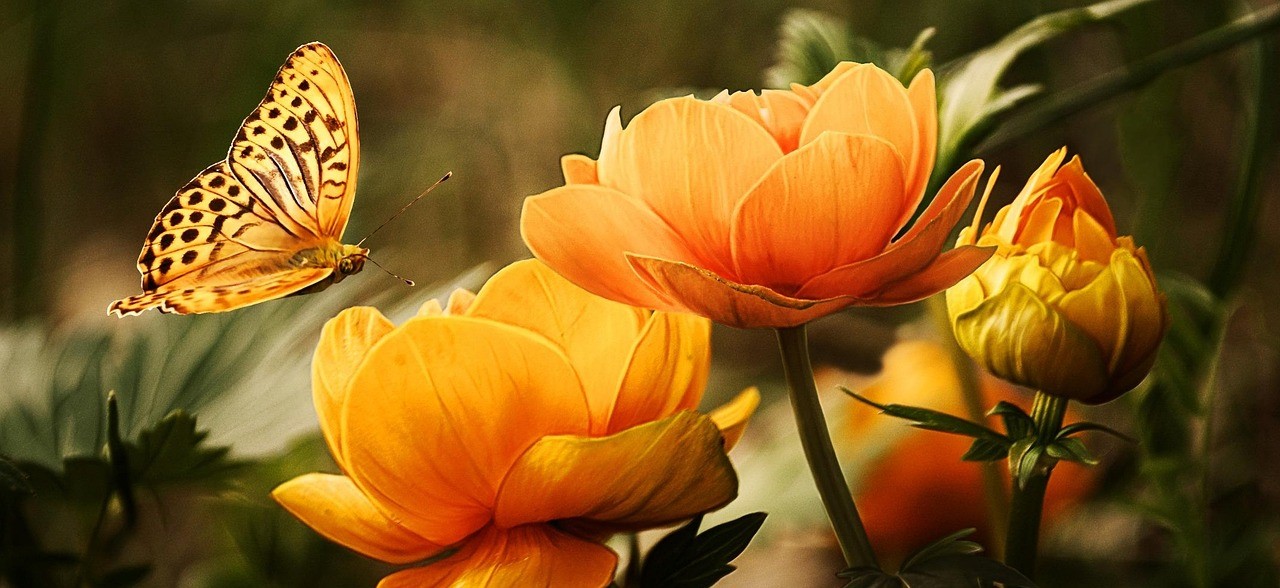
Image by Larisa Koshkina.
© The Glacier 2025. All rights reserved.
 The Glacier