The Glacier
Issue Four
Winter 2025
Her Last Great Manipulation
She let herself live till the longest day of the year, although hours before the sun set over Hemlock Island and the moon shone like a lantern over the grasses in the corral, my mother was gone.
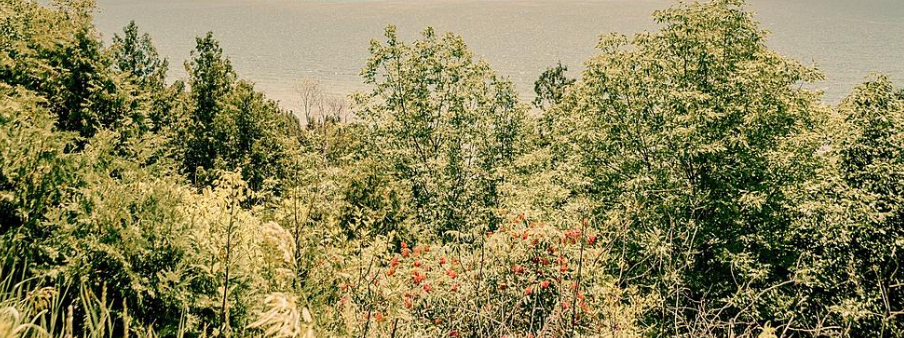
On calm days in June our lake’s a miracle of water-coloring, silvery, the shoreline a blue hazy yellow green that thickens later in the day. The grasses are fat, juicy with chlorophyll and the rains, and birdsong like baubles are everywhere in the air. You can feel the quickening lusciousness of it all. Since the 1840’s, thanks to the sandy soil and Lake Michigan’s tempering, the coastal strip from Northern Indiana to Grand Traverse Bay has been known as a fruit belt, and on Benton Harbor’s Territorial Road, there’s a boulder and a green aluminum historical marker proclaiming the fact. Established in 1860, Benton Harbor’s famous fruit market, still supposedly the “World’s largest cash-to-grower wholesale fruit market,” developed from this coastal strip. In the 1940s and 1950s my maternal grandfather, Arthur Eugene Polk Sr., drove his wild berries—blackcaps, blackberries, blueberries, and huckleberries to this market—before our channel was dynamited and dredged and our swamp drained, and the huckleberries and the blueberries, and the daisies and the cowslips, dried up and disappeared.
In Cass County, we’re on the south side of this spring-fed body of water. Magician Lake has 528 acres with depths of 20 to 60 feet, although around 78 acres or so–where you’ll find the northerly, deep lily-padded waters along Gregory Beach (which was originally platted as Magician Beach) and the old white cottages each with its Round Oak wood stove—these acres are in Van Buren County. Our northwesterly view—the best view in the world—is magnetic and sleepy, and even the animals gravitate to this southerly shore, for the far away openness, the view. I’ve grown up with this slightly tilted but keen sense of east and west. Houses must look this way, or else they’re grounded wrong.
My great-grandfather, who purchased the land in January of 1911, called the place View Point Beach Resort at Magician Lake. Born to Wesley and Mary Bielby Polk on March 7, 1866, in Lyons Township near Chicago, an only child, Edmund Richard Polk was a rotund man with, I’m told, diabetes later in life. “A wide-awake and enterprising agriculturist,” he purchased his Michigan inland lake property for $3460, including a second warranty deed for $1.00, and a quit claim deed for $1.00.
“He was afraid of the Big Lake,” my uncle Artie claimed. During the early 20th century the extended family had camped most summers in Muskegon along Lake Michigan, and carved on a board they’d labeled their huge canvas tents Camp LaGrange.
And our lake—our view is, with its longing, its ephemeral timelessness, full of hope. Look this way, it commands—and always, this softens the eyes.
Created by the channel, which was dynamited and dredged in November of 1959—the old iron bridge purchased from the village of Sumnerville and “slowly rolled by the back road and put into place, right next to where [the] huckleberry marsh was located,” a portion of my great-grandfather’s original 173 acres more or less with over 3000 feet of shoreline (the varying numbers are 3450 or 3175 or 3040 feet)—is an island. It’s beautiful. It’s a postcard.
And on Saturday, the Summer Solstice in 1986, perhaps after one last glance through the upstairs kitchen windows, beyond the cookie cutter tracery of the oak leaves and the hill that dropped low to the lake—or perhaps she gave no glance at all—my mother killed herself. It was early. After eight in the morning or so, for, like most old school dentists (he’d trained on the GI Bill at The University of Michigan and later joined the Army Dental Corps)–John Fredrick Smith and always known as Jack, his middle name misspelled, a graduate of Cooley High School in Detroit–worked Saturday mornings and golfed on Wednesday afternoons at the Dowagiac Elks Club. He wasn’t home.
That morning the planets had shifted, although I hadn’t known this then or that my world would continue shifting into what felt like hell.
“Jack can have it all now,” my mother, on a scrap of paper, had written in her childlike hand.
“I’ll be more grass for him to mow.”
“I have had it.”
And in the upper right-hand corner she’d printed: “I love all you children. Sorry dogs.”
Already she had distanced herself, claimed her awful, vitriolic, colloquial ending.
“It seemed to me her last great manipulation,” Melinda, my older sister remembered thinking, years later.
She had, I’m guessing, a jug full of Gallo Chablis, her favorite. Amongst my friends back then, I remember the expansive, delicious partying hooch-mood those big bottles splashed into being, beaded in the summer heat. She had a tall and scratched, wide mouthed glass. I never knew where those glasses came from. We had several, and: she had a bottle of phenobarbital—this I know. She had two dogs by her side, a cat in the empty redwood house high on the hill overlooking the lake. The trees were so thick you could hardly see the blue. (Some might call it a bluff, although the land slopes gently and the word feels too edgy.)
It was early for the Jet Skis, although surely the water-skiers were thwokking over the blue jump—or had it been orange back then? or trick skiing without vests languorously through the velvety lake? Fishermen, undoubtedly, were quietly casting, intent on pan fish—sunfish or bluegill or perch, or something bigger, pike or bass. And if you listened carefully, the whiz of the lines unfurled, and a little breeze shimmied the currents into motion, and the waves slopped against the boulders that lined our yard and the empty lots and my uncle’s yard, boulders tumbled there decades ago by my grandfather. “Daddy was in his element, driving that bulldozer,” my mother liked to say. (Born in Riverside, Illinois, my mother’s full name was Valerie Aline Agnes Polk Smith and as a fine-boned, slender young woman she’d resembled my father’s favorite actress, Hedy Lamarr. My aunt and my father claimed that my mother’s “snobbery” came from her Riverside memories).
There was always something plopping on the low-pitched roof of the house. The house was on four fifty-foot lots, and the wide, horseshoe-shaped drive was freshly tarred—the only tarred drive on the entire 173 acres. My grandfather and uncle had laid a handful of concrete sidewalks, little else, and I loved the compound gravel dirt roads and the dirt drives, though the cottagers and the renters didn’t.
Gwilt’s Paint Shop had recently laid new scalloped linoleum in the galley kitchen, the dining room, and the living room. Her husband had plans. Back then I’d been writing a short story about my parents, photocopying 1950s advertisements from magazines like Ladies Home Journal and Family Circle. Formica—pronounced, as the company noted, “for my kitchen,” liked to pun on gender relationships and the sexes, with catchy lines like “He says I’m `Picture Pretty’ in my Formica Kitchen, but Bob was the one who was framed,” and slangy phrases and words like “lukewarm” and “gal” and “you’re out of your mind” and “darn well” and “before he knew what hit him”—and the classic line, “every woman’s best weapon—psychology.” Many of those clichés were embedded in my mother’s psyche, and neither of my parents seemed to grasp the inferences in those ads, which puzzled me. Back then, I thought my father rather emotionally stupid.
She had time. Her son Jeffrey and youngest daughter Jennifer were off waterskiing, probably at a tournament on the Kankakee River. I was in Stratford for the festival (the other children, Melinda and Philip and Dan, had left home years ago), and Jack wouldn’t be home till noon or one or two. When he phoned home, probably, and asked the usual question, “Valerie, do you need any skim milk? Or more wine? Or a pizza from Lutz’s?” she’d be gone. Had she been panicked or calm or stoic or nervy with a kind of glee? Considering her note, I suspect it was a kind of iron anger, an iron hurt that drove her, shut her down for one last act.
I have hated her for this. And for all of the things lost, the experiences. And grieved and loved. But most especially, after all of these years, I think it is a selfish resentment that overwhelms me—a wild fury at what was lost—and I mean her and I mean the lakefront property. In 1962 my grandfather transferred, for “Natural love and affection and other valuable consideration and One and no/100 dollars,” eleven lake lots and seven “back” acres of field to my parents. This lakefront was all sold by 1992, my father having said to me once, in the early 1990s: “She should have married a richer man.” He wanted travel and cruises by then. And maybe that land meant–and means–more to me even, than she did. I don’t know. It’s been an emotional rollercoaster or a carousel (I’m reminded of St. Joe’s Silver Beach carousel) that for years, apparently, was stored away in Roswell, New Mexico.
An apparition in the making, perhaps she wandered for a while. Was she drifting or distracted? or riveted with design? I’ll never know. Strung with a braid of yellow yarn and calico, the grandfather clock chimed prettily, the floor and the walls quavering, faintly, for eight am. The trio of small windows that bordered the living room’s aluminum-framed picture windows (I’d encountered the same style windows ten years earlier, at Interlochen’s Stone Student Center)—the small windows were probably rolled open. Morning doves coo-ahhed out there. And there were many crows. They owned the land back then.
Perhaps she fed the two dogs, Sevya and Little Bit, aka Little Shit. Perhaps not. And there by the old Zenith TV she recalled, perhaps, the death of the actress Brenda Benet, who’d played the vixen Lee Carmichael on the soap opera Days of Our Lives. In April of 1982 Benet “shot herself in the head with a .38 caliber revolver.” I remember my mother exclaiming over this, her face distraught and indrawn, a kind of red watery grief, her stormy blue eyes bloodshot and red-rimmed. And she’d never again see the curly black-haired actor Stephen Schnetzer, who played the charming attorney Cass Winthrop on Another World. “Cass really sends me,” she’d once said, laughing. Her laugh had a raucous edge to it. Had it been only the lonely, the disconnected, and college students who’d watched the soaps back in the 1980s?
Under the TV was an enameled bowl from Shopping International mounded with tennis balls. While eating steak and drinking her wine, she’d bounce those balls on the linoleum for Sevya, her curly black-haired Muppet terrier mix, a gift from Melinda.
In the early 1980s on Thursdays I’d often arrive home from Western Michigan University—we were an hour’s drive from Kalamazoo. I’d step through the landing door to the tune of the syrupy hourglass theme song, the credits scrolling, of Days of Our Lives. On those afternoons the house had a strange holiday feel—darkened by the soaps, a cheap glass of wine easy for the taking.
“This house is so dark,” she’d said, on one of those afternoons. “I’d like to paint the walls.”
“That’s crazy, Mom.” I couldn’t imagine painting those beautiful rich redwood planks of wood. “Cheap from Judd Lumber in 1960,” according to my father, even the ceilings were redwood. My mother was depressed, and despite the plethora of picture windows, the house was often gloomy. But I left her feelings untouched, unexplored.
I’m sure she wore her white ankle socks and her translucent blue nightie—or was it pink? I’d never learn where she bought the short, sheer gowns. She hadn’t coughed blood in the downstairs toilet for months, from the chronic bronchitis. Physically she seemed on the mend, although she’d never lost the weight from her sixth and last pregnancy in 1968, and menopause had been difficult for her. (She was about five months shy, now, of her 57th birthday, on December 5th, the same day in 1959 that her mother, a first generation Norwegian American from Chicago’s Andersonville, Ruth Helen Munkvold Polk, had died of an aneurism). “I’m so hot and cold. This house is so cold,” my mother had complained, for what felt like years.
She drifted downstairs to my room. (In the southeastern corner of the house, it was the coziest of the bedrooms. I liked to call our house the upside-down house because all of the bedrooms were on the ground floor, and I loved the crick cricking of the electric baseboard heater in winters. I’m sure my father didn’t.) There she’d apparently opened my yellow-markered copy of Hamlet, left on the nightstand. On the floor stood a white with blue-buttoned cheap Galaxy fan, a log of cat shit pebbled with litter on its base.
I was somewhere in Ontario with my college friend Linda, perhaps eating waffles at Angie’s Country Kitchen? and cringing with embarrassment over our inadvertent clapping the night before. During the eight pm performance of Rosencrantz and Guildenstern Are Dead, after the closure of a scene, we’d leapt to clapping enthusiastically, and I’d been mortified. Although our noisiness had surprised the actors and probably bemused the scant audience, it hadn’t, as I’ve concluded over the years, been an earthshattering error.
We’d invited my mother along. Linda was a good sport and wouldn’t have minded. “Oh, you don’t want your old Mom along,” my mother said. I still see the three of us laughing together in the family room, the sofa covered with a ribbed green cotton bedspread, the flowery green and white curtains from our previous house in Saginaw.
That summer day, beyond the picture window, blue spruces rose beside the porch railing. A striped windsock and an MSU windsock hung from another tree, and a bamboo chime, with notes of E and C, sounded over the open heavy pine door. The exterior of those pine doors with their beautiful knots—there were four of them in the house–had been painted turquoise. I hadn’t pressed the issue. And so What if my mother had come along? has haunted me.
For years I’ve wondered over my self-absorption—a carelessness with regard to others—an inattentiveness that has sometimes bordered on zero empathy, as though emotionally I’m a flat pan, an empty well. And this habit of response has led, time and again, to silence, to a mum disregard for feelings—and to grief on all sides. Things don’t get talked about.
I’d learned, years ago, to clam up like my father.
She printed with a blue ink pen “Thank you, Sarah” in the bottom left-hand corner of the Barbra Streisand Broadway album I’d given her for Mother’s Day. She had trouble etching the words into the cardboard (she remembered her comma), and the words look printed by a four-year-old’s awkward, unpracticed hand. What else had she done that morning?
(For years I’d thought phenobarbital pills were large capsules, but they’re not. They’re small round white tablets, and so it’s easy to swallow a handful.) I don’t remember where she left the album—probably in my bedroom. It sickens me to look at the cover of the album, the navy blues and burgundy velvet, Barbra there, and my mother’s three words. It’s a queer yellow awfulness that knocks me out. The things of her life cherished by her that day, in that year, sicken me: (including my Arabian Horse World calendar, ripped to the month of June, 1986, with My Gypsy Fire peering over her bay shoulder, a purple iris in the background). This calendar I’d rolled up and stashed in a box along with her copy of Lake Woebegone Days, I Heard the Owl Call My Name, Under the Lilacs, How to Win Over Worry, A Book of Nonsense, and All Things Great and Small. It was thirty-seven years before I could bring myself to open James Herriot’s green book, finally encountering her own delight in those pages.
And so, in her bedroom, before the south wall of pink fireplace bricks, kitty-corner to the cherry wood dresser with its oblong mirror, the drawers arranged with her boxes of jewelry (I had turned up my nose at the Norwegian pewter pieces—“They’re too heavy,” I’d said, of the square-linked stuff.). I remember her blank, stunned-verging-on-tearful face, at that moment. There were delicate, framed yellow finches on the east wall—the west side of closets thick with shoes and dresses in plastic storage bags, and some of the dresses were vintage, decades old. There were several of Muriel Chandler’s Caribatik silk gowns from our trips to Jamaica in 1974 and 1976. (In a 1975 fashion charity show for Marshall Fields, which featured designers including Oscar de la Renta, Bill Atkinson, Pauline Trigere, and Gunther—and herself, Muriel Chandler’s cotton and silk batiks bedazzled the audience.) In the late ‘80s, with a series of donations and garage and rummage sales, my father dispensed with most of my mother’s things. “All of these things make me panicky,” my father once told me.
She gathered her paraphernalia and poured her wine. Did she swallow the pills one by one or slap them into her mouth by the handful? Such strangeness, this feeding one’s mouth with death or sleep. I remember her nightly routine, standing in her short gown before the galley kitchen counter, the lake far below, swallowing whatever with the well water. Then she’d smooth Vanda moisturizer over her face. I’ve one of the tall and tapered ivory bottles, lavender capped, stashed under the bathroom sink—a whiff of its sweet pearly smell and I’m there with her, upstairs or downstairs, and she’s washing the cream into her skin.
I’ve wondered, did she take the Phenobarbital nightly? Or was it Valium? Who’d prescribed these medications? Possibly my father, for, as a dentist in the 1980s, he could write prescriptions for most anything. Was Sevya, her little dog who slept with her always, by her side? Who’d be savaged by a neighbor’s Akita not once but twice, months later (I remember her cry, like a human screaming in our back yard.) Who was there?
My mother’s face, the thin Scottish lips a Noh mask, all frown—Munch’s Scream in many versions? Grief-stricken and fierce, the blind swirl into vomit and blank, black, sunk, her breathing slowed? Where was Little Bit? The Baby Ben on her ivory painted nightstand ticked on, or perhaps she’d forgotten to wind the clock. Had it stopped days ago? Where was Lani the cat?
Tucked in the closet, by the sliding glass doors (once my mother hoped for a master bath beyond those doors), her husband’s piggy bank, beige and orange, a brown sombrero-hatted Speedy Gonzales, or a prototype of that cartoon character and crammed with coins, grinned atop the beat-up, buttermilk yellow dresser. His second wife threw that bank away, along with my mother’s collection of tiny ceramic frogs, realistic and google eyed. My father kept a handful of her possessions, not much. And he was happy, I suppose, to have his wives throw the rest away.
I hadn’t known that evening in Ontario, swimming in a sea of ticketholders and struggling to decipher Brent Carver’s Hamlet so far away on the Avon stage, that she was dead. There’d been no moment of sudden knowledge that morning, no prescience, although a generalized anxiety had plagued me all weekend.
(I still have the Ticketron ticket, John Neville, Artistic Director. #05213 for $22.80 purchased by me on May 22nd, 1986. Location 200 RCH, Left section, Row S, Seat 1 for Saturday, June 21st, 1986, 8pm.)
And while she was dying, I’ve imagined: her son Jeffrey thwokked over a jump, landing with the pull of arms and spray; Jennifer clapped by the shore and tugged at her Speedo. In Santa Monica Melinda was fast asleep, and Phil the dressage rider was trotting down the centerline somewhere in Ohio. In Detroit, tending to a stab wound or a gunshot wound, Dan was up to his arms in blood, and her husband, Jack, was fifteen minutes away in Dowagiac, cussing over a root canal—pounding his fist on the receptionist’s counter, and water was gurgling in the spit bowl. And then nothingness. The dark swirl, her breathing stopped.
I hadn’t known then, what was lost, or that everything had funneled into an awful O–the finite end of a scope. Round, yellowing sun blackened—burnt sky high over Hemlock Island—there, still, forever.
Sarah Jane Polk Smith is the author of No Thanks and Other Stories published by New Issues Poetry and Prose. Her stories have appeared in New England Review, Passages North, Third Coast, Other Voices, The Madison Review, and elsewhere. Her short story “Turtle Hunting With Black” received an AWP Intro Award; “No Thanks” was a Pushcart Prize nominee, and in 2003 her work received a D.H. Lawrence Fellowship. As S. J. Smith, she worked briefly as a stringer for the Kalamazoo Gazette, writing feature stories primarily about local farms and the environment. She teaches at Lake Michigan College and is currently working on a novel set in Southwestern Michigan, where she lives on Sarah Jane’s Polk Channel Farm alongside two horses, five cats, and many strays.
© The Glacier 2025. All rights reserved.
 The Glacier