The Glacier
Issue Three
Winter 2024
What is The Biological Function of Words
Why are they a river with no beginning nor end
nor mother who turns out to be
just another human, another condemned passenger
at the water’s edge and her soft brown antlers
the shadow of a thought?

Words are not dancing, which is said to be
indicative of feeling happy, playful and free.
I can’t really argue with that, except
I recall Betty Boop had to dance
when they shot bullets at her feet. What bastards we are.

Not being able to stand knowing what you know
you must be actively ignorant
and your ignorance polished
to a shimmering tumor, pressed against memory;
a labia of sorrow, sorrow’s legend, while a little frog dances
the Charleston, only when no one is watching.

Now go ahead. Come and tell me
I’d made everything up. Well, maybe I have.
But even that means something.
I always want to say profound things to you.
A dirty thought like a cry at dawn.

Deer in the Queen-Anne’s-Lace trample the sward
and part the grass, as summer moves on
under a moon whose light is not even her own—
and words, leading up to something incredible,

lonely and honest, flowing between the embankments
toward a colossal event—words
fail me. It’s normal to hate words. And phrases, like
He lost the battle against depression, and
Let me be perfectly clear—and yet they come,

my God they come to us like sunlight,
reflecting off volcanoes on the moon,
they come to us like rage and love
and disencumbered, they avail.
The Temptation Of St. Anthony
In the paintings his face is often averted, turned upward
toward the always unclear God
or staring straight at the creature composed
of animal human parts
or else he is staring straight ahead, as if at us
the supposed viewer and
he appears to be drowning
surrounded by a gleeful orgy
a corpse with spindly legs and nubbed feet
rearing over him—they perform for him.
The Queen of Sheba, with her coterie
she comes with an enormous illumined ornate manuscript,
opened for him
reflecting light from an unknown source
no doubt filled with esoteric knowledge—
and still he resists.

But what he sees not, we see.
The elephant with a woman hanging off its trunk, men in striking profile,
slobbering mouths, everything pleading for dick,
for the dick of the eye for Christ’s sake!
They want in. And we’re in.
The translucent shawl gathered in skilled drapery
like butter raked over with a fork—

Pity no rage at the light.
Pity no whore at your feet, who is you!
Pity no monkey holding a plum to the mouth
of a stripped-down world—you stripped the world
when they stripped you into it
and you knew you would go out and strip them for it
your need enchained to a legendary need
and you went stripping the eyes
off the heads of your dolls
went tearing your eyes out of the I’s,
your joy, that which is graver than,
and more lonelier than
anything else—
you locked into a stare, and went tearing the world—
well, now...

What he sees not, we see.
What he sees, we see not.

And we’re watched by a pig
with a little bell around it neck.
And ever the man at the center is there—

If I did it all again, he might suddenly look up and say,
It’s not really about me, is it?

And you might admit, No. It’s not really about him.

It’s about painting and change and stillness.
The transference of light, making
the moon seem halved, and your tortured nothing, your invisible
charge you stand before,

the event of it all, curative and more violent
than the narrative of your life will ever be.

The contextual, with its symbolic marginalia
drifts around your skull.

You keep waking up with a moth eating a green sun,
you keep waking up trapped,
the aporia, with no metaphor—but looking at the paintings

until you notice in one
a stag, standing and staring from the distance
of the so-called background.

Backgrounds see the fore and seem to know
something else.

And beyond, another background....
Surely some art historian could explain this!
The way the unseen gets in
and stares back at you.

Like you can reach a status of zero.
There, but only implied.

See how he sits beside a vanitas skull, and his book,
for in his restraint, he has grasped the other world.
The Anxiety of Meaning
Certain events of love
drew my body nearer to meaning.

All poets are liars.
Wrecked against meaning. Starved
on the beach of meaning—

I want to keep your head in a black bag, I said.

Who can distinguish the remembered
from the desired? I know a little
the agony of it. I drew nearer still.

What do I know about getting?
I know my mother turned away.
That I slipped from her body again and again,
tied down in an incubator and punctured
with a life-saving light.

I know that all that time
an ancient poem
was writing itself in the
hallway, where a mask hung on the wall
looking without seeing.

I know I turned away. Can you feel it?
How the head longs to rid the face
of a certain danceless dance. That we were

condemned to dualism at birth.
Dualism is dead.
And long live dualism.

That certain events of love
drew us nearer to mean.
That the heart is chilled
by a tormented wave

that thinks it is not the sea.
Bianca Stone is the author of over five books, including the poetry collections, What is Otherwise Infinite (Tin House, 2022) winner of the 2022 Vermont Book Award; The Möbius Strip Club of Grief (Tin House, 2018), Someone Else’s Wedding Vows (Octopus Books and Tin House, 2014) and a collaboration with Anne Carson on the illuminated version of Antigonick (New Directions, 2012). Her work has appeared in The New Yorker, The Atlantic, Poets and Writers, The Nation and elsewhere. She co-founded the poetry-based nonprofit, Ruth Stone House, where she teaches classes on poetry and poetic study, hosts the Ode & Psyche Podcast and is editor-at-large for ITERANT magazine. She is the current Vermont poet laureate (2024-2029).
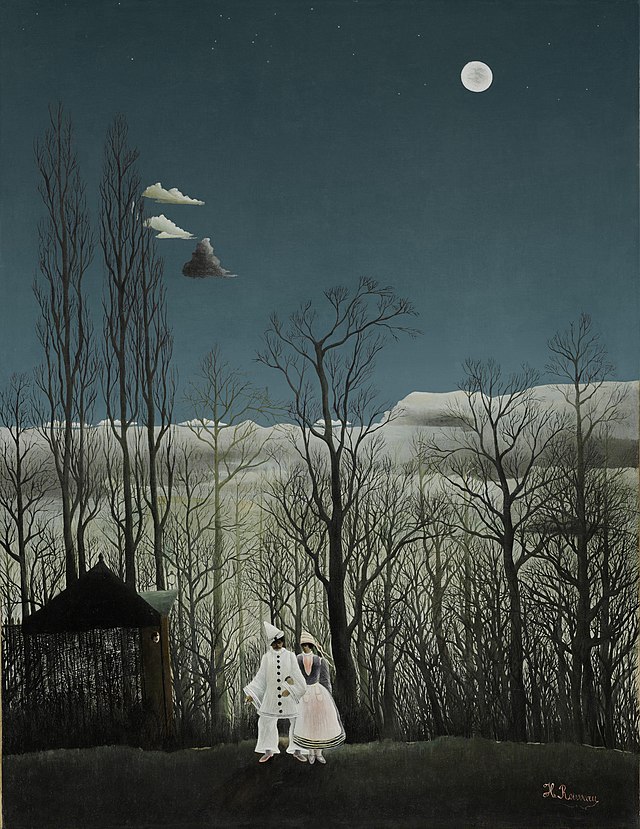
Artwork by Henri Rousseau.
© The Glacier 2024. All rights reserved.
 The Glacier