The Glacier
Issue Three
Winter 2024
Carp are Dying of Herpes in Babylon
In Wyoming, a house cat
has been diagnosed with plague.
In India, an elephant calf
has died from anthrax, which,
in Malawi, has claimed
the lives of forty-five hippos.
Outbreaks of salmonella,
less deadly, but more common,
have been triggered world-wide,
by chicken nuggets in Canada,
powdered milk in France,
a pet hedgehog here at home.

Always, it’s the exotic that
fascinates—Rift Valley Fever,
Seneca Valley Virus, the names
reassuringly localized, as foreign
as Ebola, now found airborne
by a particular Liberian bat.
For the familiar swine fever,
measures, of course, are taken,
the slaughtering, by the thousands,
of Japanese hogs. Denmark fences
its border to protect itself from
the threat of infected boars.

Those responses, naturally,
have been applauded. Something
must be sacrificed or barred
for the country’s greater good,
and so far, after all, it’s merely
been animals, the decisions
difficult only in the abstract.
Although now, at Sarasota,
five horses have presented
with fevers and coughs, and
they have been quarantined
like our neighbors or like us,
pending their test results.
And yes, it’s been verified
that people remember better
what is said if the memory
of a sentence remains,
until its very end, unclear.
Unmoored
Last night, explosion in a neighbor’s garage,
The fire consuming the bulk of their house
Before hoses were unspooled. This morning,
The damage visible from our upstairs windows.
Sometimes, we manage weeks without thinking
That what we are is temporary. Have you
Ever sheltered in place, ominous clouds
Tinted bruise-green, the wind carrying what
Has been forecasted as a ruin of heavy rain?
I’m talking about a place where the highway
In and out of danger floods so often that
River sediment seems its surface. Where,
Falling asleep during downpours is like
Leaving active flames in your fireplace
Like my father did, trusting the cheap grate.

There is a story my worst students loved.
A father and son travel by boat to an island
Exposed by low tide. The small skiff, secured
Improperly by the boy, drifts away. Nothing
Can save them, yet none of the students
Ever blamed the boy for his fatal error.
What they loved to talk about was how
The father lifted the boy to his shoulders
And steeled himself as the ocean water rose.
The students, seventeen and often sullen,
Waved their hands to volunteer stories
Of their own about making terrible mistakes.
In that town, years before, a family had made
A fortune manufacturing Jello. Even then,
Two of the dead eyes of its factory windows
Remained unbroken. None of the boys would
Admit to liking Jello, but among those students
Were many children and grandchildren
Of men and women who had once believed
In the longevity of their work with sugar,
Powder, and dye. Even then, years before
The factory became unmoored, they would
Tell themselves that inevitability had not
Already begun. What they made so cheap
And colorful that it would always be boxed
For delivery within their neighborhood.

Now, a museum for what the town has lost
Is housed across from that high school,
As proximate as the fire-ruined house,
Its owners unmoored so catastrophically
That they chorus, “Who could ever imagine?”
As if stupefied, sounding like my father,
The widower, who, for decades, was stunned
To be living alone. Each time I visited,
He sank more deeply into the only chair
He ever used, his eyes sweeping the walls
Of the small living room as he murmured,
“Who would have thought?” Something I said
Aloud, just before sunrise this morning,
As I walked, uneasy, by my neighbors’ yard
Into a dedicated, half hour of solitude.
Though, when I returned home, the low sun,
From a cloudless sky, cast the shadow
Of the undamaged, next-door house over
The scattered debris, accidental as
What remained of the impossible.
Gary Fincke will have two poetry collections published in Spring, 2025: For Now, We Have Been Spared (new poems, Slant Books) and The Necessary Going On: Selected Poems (Press 53). His poems have appeared in such journals as Harper’s, The Paris Review, The Georgia Review, Poetry, and The Kenyon Review.
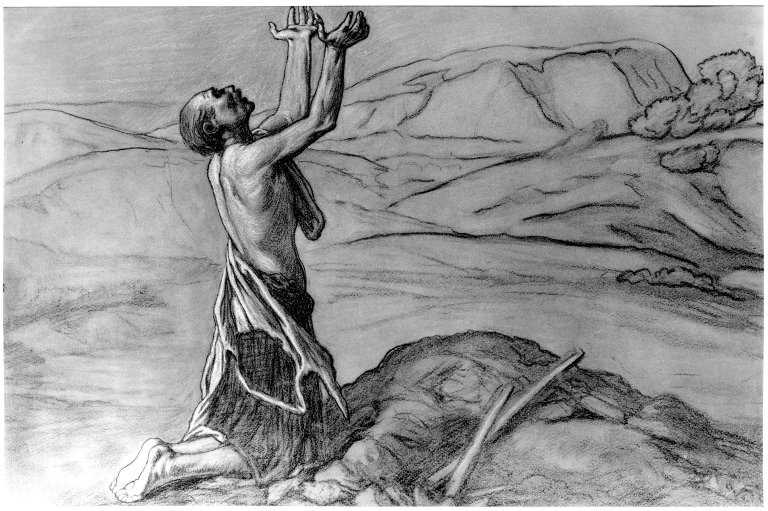
Artwork by Elihu Vedder (Creative Commons).
© The Glacier 2024. All rights reserved.
 The Glacier