The Glacier
Issue Three
Winter 2024
Richard’s Hat
Was it Kafka who learned about America by reading the autobiography of Benjamin Franklin?
–Richard Brautigan, from Trout Fishing in America
I kept dreaming of Brautigan’s girl on the cover of Trout Fishing in America. It was his funny muse in her granny glasses, black leather boots up to her knees almost poking out from her seated position on the base of Ben Franklin’s Statue in Washington Square Park, San Francisco. He was towering above her, his hands buried on his hips under a dark jacket opened up to show the vest and love beads he was wearing. His spectacles were gleaming under the broad-brimmed tall taupe hat. His mustache spoke to the camera as much as his hands hidden behind his back, as if he was preparing for a magician’s trick. Maybe his trick was to strip the girl’s clothes from her hippy thin body, her doily lace band tied around her head almost in surrender to him. But she was his muse, this woman whose name was Michaela Le Grand. If anything, she stripped him of his senses. She returned them in words he could have written on the back of a manila envelope for a whole chapter.
My copy of Trout Fishing in America rested beside my flashlight. I was tired of the Civil War in Big Sur and the good old Colonel Poague who smoked cigarette after cigarette outside the sailboat on blocks: my home. He would be spotted by the local police and escorted to an insane asylum. They had many of them in this town of nothing. But for now he chain smoked and mumbled his regret that the South had lost the war. I was too afraid to open the hatch. He was capable of doing anything.
The first knock came at three a.m. and I grabbed my flashlight for a weapon. I had no idea who it might be in the cold. But there were more raps on the hull. I started to pull on my pants to be ready for anything. I heard her voice. Husky from smoking cigarettes but with a sweet inflection as she phrased this strange message for me.
“You have Richard’s hat,” she told me. “Can you open the hatch?
But I didn’t know what hat she was talking about, a hat Mister Brautigan had left at the hotel? That stovepipe with the broad brim was right here, and her voice became not so whimsical now.
“Let me in, cold out in this forsaken wind.”
“Richard’s hat? You mean the one he wore at the hotel?”
“Exactly, my friend, the one Richard wore at the hotel.”
There was a pause that allowed the wind to shriek and the lines whipping around the mast to rattle their chains. I didn’t know if I wanted to let in a character from his fiction. It was hard enough to get rid of Colonel Poague who had escaped from A Confederate General from Big Sur. But here she was outside Telemachus, the sailboat I slept in every night and had the strangest encounters with characters from Brautigan’s fiction. She was not from inside Trout Fishing in America but from the cover. I thought she would go away, or my mind would move on to another obsession. My girl in Paris filled up my thoughts nightly, lying there usually naked in my sleeping bag. Her blue eyes and soft alabaster skin, long black hair that she wore past her shoulders. Obsessions, or the lack of them, like my inability to write a single line of poetry. I blamed that on Brautigan, why not, I considered, and my not working at the hotel where I had first checked him in as a guest.
“I am still here,” Michaela spoke, not bothering to rap on the hull. I wanted her to return to the cover of Trout Fishing in America. She wouldn’t disappear at all back to the small stool she sat on next to Franklin’s statue. She had the funniest look on her face. Her granny glasses allowed her bullet eyes to penetrate the distance of the cameraman with his Polaroid. His name was Erik Weber. He didn’t know he was making history with a snap of the shutter. The man who had written about fictional creeks was standing above her with a slightly bent knee. I couldn’t stop picturing his Playboy on his bed or his dead eyes. When he had asked me to check on his room’s toilet I hadn’t expected a glimpse into his dead soul.
“I want Richard’s hat, I know you have it.”
I was looking at it right now, in the corner of the cabin next to my empty bottle of wine. He had been wearing his hippie hat of a pilgrim when I had checked him in at the hotel. His hand offered a signature that night, leaving him naked. He would walk to the elevator and disappear for a moment. Then come back down for the night ahead of him.
“I can’t let you in, you see you are only a woman on the cover of his book.”
“You know I am much more than that.”
“You don’t know my girl is in Paris and she may never come back.”
“I am not going to eat you.”
“If I open the hatch and give you his hat you will leave me alone.”
“You don’t understand. I was Richard’s muse. They called me The Muse and that’s what I ended up on the cover of Trout Fishing in America.”
“A book that had nothing to do with trout fishing.”
“Are you going to let me in?”
I decided it was the only sensible thing to do.
Soon she was crouching beside me in the dimly lit hatch. My flashlight could only last so long too.
She was taller than I had expected, and had to double over more than me. I shined the flashlight on her face. Her granny glasses held the shimmer. She looked like a cat, some wild kind of cat that had crawled into Telemachus to do what. She smelled of San Francisco. Incense and oranges and tea, some other exotic hints of the Orient. In the end I decided she smelled of success, of a writer’s portable typewriter and its river of a ribbon turning up the flotsam of the imagination.
“Where is his hat?”I handed it to her. I thought she’d leave. I didn’t know if anyone had seen her crawl on top of the sailboat and wait for me to open the hatch. The Lake Superior waves were still firing their cannons. I thought of Poague, if he could be creeping around in my head and out of another book by Brautigan, even more problematic because it involved the Civil War and General Robert E. Lee.
But she touched my wrists. Was she inspecting them for suicide attempts? The clean razor cuts that would produce blood and cause dizziness eventually, ending in death if someone had not discovered the attempt. I couldn’t do that to the sailboat I had called home these winter nights. Make it a crime scene, more or less.
“Let me talk. After I am done I will go.”
She let go of my wrists. I hadn’t realized she had been touching both wrists.
“He loaded his ten-year-old Plymouth station wagon with camping gear. A Coleman stove and lantern, tent and sleeping bags. It also included Ginnie, their daughter, Ianthe, a portable typewriter and a card table. They headed east from San Francisco which would turn out to be their honeymoon, getting married in Reno, Nevada.”
“Why didn’t he take you?”
“I was only his muse. He didn’t have room for me in their station wagon.”
“Why didn’t he put Ginnie on the cover?”
“You display the muse, not your wife.”
“Why are you telling me this?”
“You want to know. I can sense what’s hiding in those trout streams that are fictional. It’s not fish.”
“I don’t know much of anything. My girl is in Paris. I don’t have a job or money to buy gas for my station wagon parked at the hotel.”
She took off her cap. I hadn’t seen her hair clearly until then. It was peppered with gray, curly at her shoulders, and her front teeth kind of jutted out in this sexual way I guess.
“They headed for Idaho on U.S. Highway 93. Past Twin Falls. And camped at Silver Creek, Idaho, where Brautigan fished for regular fish at first. He recorded the other creeks he fished in a notebook: names like Copper Creek, Little Wood Creek, Big Smokey Creek, Paradise Creek, and Salt Creek. Many more creeks.”
“Why didn’t he take you?”
“I was his Muse, not somebody to frolic with his tent. That was Ginnie’s job.”
“What job?”
“To keep him sexually happy,”
“Her only job?”
“She had other tasks assigned to her. Like scrubbing the pots and pans every day, cooking breakfast and dinner. My task was to pose with Richard at the Ben Franklin Statue, to sit on that small stool and bend my left knee. The photographer said eat the camera, I didn’t know what he meant at first. But I ate the camera and there I ended up on the cover of a million copies.”
She had this queer way of smiling as if not smiling. She wore the same pair of wire-rims as the cover, and even though her shoulder length hair was laced with gray strands she appeared young and skinny as she bent over in the hatch. I could tell she was listening for something. Maybe she expected Richard to show up. He had already been here the other night. What he wanted I couldn’t tell, and perhaps I had only dreamed of him.
“Are those cannons firing?” she asked about the Lake Superior waves. I shook my head, wondering what she was going to do with Richard’s hat, if I was even willing to part with it. I had no idea if she would ever see Richard again; and what did I care? My girl had gone to Paris and I was left alone in the hatch of Telemachus, to be arrested some night. I wanted to return to the hotel and sleep in my old bed that reminded me of her body. I could imagine her black-haired head on the pillow, her hip anchored onto mine, and the way she breathed unevenly at times.
I pictured that loaded up station wagon heading across America for fishing creeks. For a novel to be born beside the mirrored reflection of a clear creek, the typewriter rattled like somebody’s fascination with mechanical objects.
Did it scare the fish?
The trout in those telephone booths were good fellows. They were always ready to make a call, even a long distance call.
He collected them by the dozens. They were never left hungry if they had a nearby creek, or if he had to hitchhike and catch rides with farmers. Ginnie and his daughter were left alone to play house in the woods.
I worked my way slowly out of worrying about her intentions. Let her have the hat. Richard may never see it again if he takes up his shotgun and cleans his teeth with a double gauge.
“What are you looking at me like that for?” I asked her, her big teeth didn’t fit her smile, but was she really smiling? I never knew if she was a witch about to put a spell on me. She bent her head in acceptance of my fate. What was she going to do with that damn hat?
She spoke under her breath: they were words beneath a rushing waterfall. She touched my shoulder. She was going to kiss me but didn’t.
I thought of my wife, not that she was my wife then. She was my girl who had gone to Paris where I couldn’t touch her. But she kept my head busy with my longing for her: sitting on our hotel bed, making spaghetti with our hot plate, taking the milk away from the window ledge to pour into a coffee. She should be sitting beside a statue of some other American great as my Muse, with her black hair the color of a moody Bronte landscape seen at the moors.
Michaela did kiss me then. Her lips tasted of cognac and the cold winter night. I trembled with her tongue down my mouth. I thought of trout in telephone booths, riding elevators in the woods, creeks called Stalingrad, for the cold desolate nothing that wilderness could become for a mind. It was Michaela’s mouth that suddenly opened like hell’s gates. She touched my cheek, rubbed the back of my neck, and suddenly her pointy breasts were peeking out from her bra like sexual trout.
“What are you doing?”
“Do I have to get out a writing pad and draw it for you?” she replied, sliding her body up against mine.
The water outside sounded like an attack with Colonel Poague’s cannons. Blasting, again, and again, and the sailboat masts shook in the gale force wind straight from some Edgar Allan Poe story of horror. She barely allowed me to breathe with her mouth suffocating me with kisses. Her tongue was a weapon, and I couldn’t help but recoil thinking Brautigan’s Muse was voluptuous clad only in her panties. Her bra straps hung from her shoulders. She asked me to undress. I choked on her tongue, and then heard someone else rapping on the hull.
Richard Brautigan himself, I thought, or Colonel Poague, maybe even Trout Fishing in America Shorty, fresh from a frozen creek called Snuff, not realizing he was in the Upper Peninsula and every stream, rivulet, and creek gleamed with surface ice an inch thick.
“I know you are in there,” a gruff but not so unpleasant voice said.
“That’s him, Trout Fishing Shorty,” she said.
“How did he get here?”
“You must have imagined him, or your novel is lying open turned to one of his pages,” she said carefully, with her bra on but not entirely covering her sexual trout.
“Is that you Shorty?” I blustered, and heard furious raps like one freezing to death.
“I didn’t know it was going to be so cold here.”
“Shorty, quit following me in your wheelchair. We both know Richard is going to blast his brain apart with a shotgun. I can’t stop him, I have his hat in my hands, if he opens the hatch for you, you can come in and talk to me,” she blurred along with final kisses and tongue down my throat.
I unopened the hatch.
Below me was a short man with a wrinkled trout face and hunched shoulders, as if he had been squeezed into a cannon and catapulted outward.
He climbed up, holding onto a rope I dropped for him.
“We got to close the hatch and not be seen,” I told him hurriedly, as he launched himself through the hole leading into the sailboat.
Before I shut the hatch I watched the moon above. A marbled fixture of a completely rounded luminescence. Clouds rolled over it, diminishing its glow, but then that round fixture in the winter sky stared down at me again. I heard Muse and Trout Fishing Shorty talking. I didn’t want to think too hard on how Michaela had inspired Brautigan to write his fiction on trout fishing.
But anything was possible in the dream world that Richard had created. She wasn’t there at the campsite where the portable typewriter roared to life scaring away blackbirds who came looking for fish bones and flesh.
Somehow she had intruded within the pages he accumulated. Late at night, by kerosene light, the murderous wilderness coming to life, all the creeks he had visited tapped into place on pages he ripped away from the platen and piled up. Her mouthy voice directed him to add one more creek’s name like Stalingrad. Even if it didn’t exist, it might as well with all the biting mosquitoes. It was Ginnie’s body he feasted on later in their sleeping bag. Sometimes their daughter slept between their lovemaking. When Richard seeded Ginnie yet again that night he felt her presence settling above in the lonely clouds.
The police car lit up by the moonlight came around a shadowy corner.
“I’m not going to let you have Richard’s hat,” Michaela was telling Trout Fishing Shorty, who burst out yelling.
“Shut up,” I told both of them.
I reached over for the flashlight and shut it off. I never knew if Telemachus had holes or cracks that let out light for any cop to see. I listened carefully if the cop car was slowing to a stop. It was hard to hear exactly anything outside with the waves exploding over the breakwall. I knew they flashed their searching lights over the sailboats. What were they going to find? Somebody sailing away across the parking lot. Or how about a sombrero made out of ice that fell from the sky frozen?
The wheelchair banged around in the hatch; he was making a terrible noise and shouting out creek names he had been to. Like Salt Creek or Pretty Boy Floyd Creek. How did he become a character in Trout Fishing in America? A crazy old geek with a beer in one hand and a fishing rod in the other. Didn’t the wheelchair scare away the trout? Trout Fishing Shorty was now wearing Richard’s hat. Too large for his head, it swallowed up his skull. It was then I thought about Brautigan’s poem. Of somebody eating a dish of ice cream that looked like Kafka’s hat; of the sexual nature of the hat, the ice cream tasted like an operating table. But what did Kafka have to do with it right now? Her breasts did all the talking, their large areolas wobbling a bit as she trembled in the cold.
The police car had definitely stopped this time. It was only a matter of time before they found me living in the sailboat. I feared everything then. Like a bad dream, I knew a badge was walking forward. What had they seen? A finger of light through the hatch riding up into the night. He wouldn’t want anything but the truth. His radio chatted about a murder and burning houses and missing women, as if they were all connected tonight. I thought about trout emptying from creeks in Idaho and jumping into words on a typewriter.
I could never find any words to tell her how much I loved her.
I missed her body.
This was what I was thinking as I stood on the deck of the sailboat about to jump.
She possessed something George Frederick Watts would have explored in all his nudes he painted. A heaving belly of one as she lay in profile touching heaven above her.
I found myself wading through Stalingrad Creek, wearing this very hat instead of Brautigan. I carried his typewriter with me. I saw her on the shore waving to me. She had come back from the City of Light. She had taken off all her clothes to remind me what I had missed.
I was carrying the typewriter and felt responsible for the words I could be typing right now.
On a log that rose speckled from moss I set down the typewriter. My lover was calling me. Her hips belonged in a George Frederick Watts painting, or one painted by Edward Burne-Jones of a woman beguiling Merlin with her slender body wrapped tight in a linen dress that seemed difficult to remove. It would need the constant attention of a lover. The typewriter keys rattled. Maybe I was typing her into this unreal story I had been writing in my head for weeks. Her nose appeared on the page, more or less, misspelled as woman, and she was a woman, but it was her nose I wanted to leave in print. Its hooked quality of a maiden from King Arthur’s Court, her alabaster flesh that gleamed purely from her toes up to her neck in moonlight. And she leapt in the air, shouting and waving, her shiny black hair falling around her shoulders, when she jumped up and down for me to pay attention to her.
I was wading in Stalingrad Creek, right through the woods from Smokey Creek, and she kept waving to me. I couldn’t shout from the creek, holding the typewriter above my head. I was coming, slipping over shadowy stones in the water, watching a trout stare at me in disbelief.
The sun above was a massacre of heat.
I started taking off my clothes. It would be a cold swim through Stalingrad Creek. I thought about the Russian soldiers who had died in war. Their faces boyishly like marble at their time of death. They would never make love with a woman. A body with its pale roundness clasped in a moonlight that dripped like honey.
“If you love her,” Michaela told me, “then you need to close your eyes and just jump.”
She had drifted to the other side of the sailboat, partially undressed you could say before walking in some other direction.
I did love her.
It brought me back to reality. Her body, I mean, as I stood on the edge of the sailboat.
I threw my shirt and socks at the cop who kept staring as if he were watching a horror movie.
I still clung to the typewriter like an anchor.
I saw Colonel Poague waving his arms before an old rusted-out truck. What did Richard imagine all his characters would do after he had died? If they continued to haunt readers of his books, even the most strange ones, was up to his publisher who kept making money off books like Willard and His Bowling Trophies. In this odd fable a woman was gagged, her mouth was delicate, her tongue sculptured and pink, as they made love on the floor.
How he got Shorty’s wheelchair into the cab of the truck was not known.
Poague motioned for me to jump, now would be a good time, before it all became a memory and was over before it had begun. Crouching with the typewriter, I suddenly jumped into the whiplash of wind and wondered if I would turn into an animal, cast into the Underworld by Circe who was laying treachery throughout the bitter Upper Peninsula night.
I landed, and laid sprawled in the snow. And got up, achingly.
But I oinked as I ran away from the policeman who called for backup to the waiting truck. “What’s wrong?” Shorty asked of Poague who had trouble shifting gears. What did he know of driving a truck, a man from the Civil War trained in artillery?
Shorty breathed rapidly, hyperventilating, as if he were marching toward a Union army somewhere in a field. He drooled trout. His eyes rolled them from one orbit to another. Finally, the gears ground together, and we lurched forward through the snow and time itself about to expire on this story.
Somewhere in the woods my beloved waited for me to splash through the clear creek to her, but we were lurching down a snowy road. If I could only drop the typewriter to the floor I’d be more comfortable and have a chance to relax finally tonight. She looked sad, suddenly far away from me, and I was wearing Brautigan’s hat, the one he wore on the cover of Trout Fishing in America, a book that would never aid you in catching any trout or women.
What did Washington Square and Benjamin Franklin have to do with sex anyway or a station wagon loaded up with a tent and sleeping bags motoring down a road with the radio tuned to Beethoven? His girl Ginnie rode on his shoulder as he lazily turned the wheel to avoid any crossing trout and his young daughter Ianthe slept by the window side. Her head was full of whispering trees and noisy shadows as they danced through the open window. Her eyes with that curious writer’s stare only daughters of famous men like her father had while viewing the living world.
Russell Thorburn is the author of four books of poems. Somewhere We’ll Leave the World, published by Wayne State University Press, draws on the poet’s own experiences while imagining fictional characters and personal heroes. In a previous book, Misfit Hearts, he chronicles the making of The Misfits through the filming-location photographs of Clark Gable, Marilyn Monroe and Montgomery Clift. In Let It Be Told in a Single Breath, his latest book published by Cornerstone Press, University of Wisconsin-Stevens Point, he picks up where he left off with recurring characters and a younger self in dislocations of time and space. He has received numerous grants, including a National Endowment for the Arts Fellowship. The Upper Peninsula’s first poet laureate, Thorburn teaches composition at Northern Michigan University.
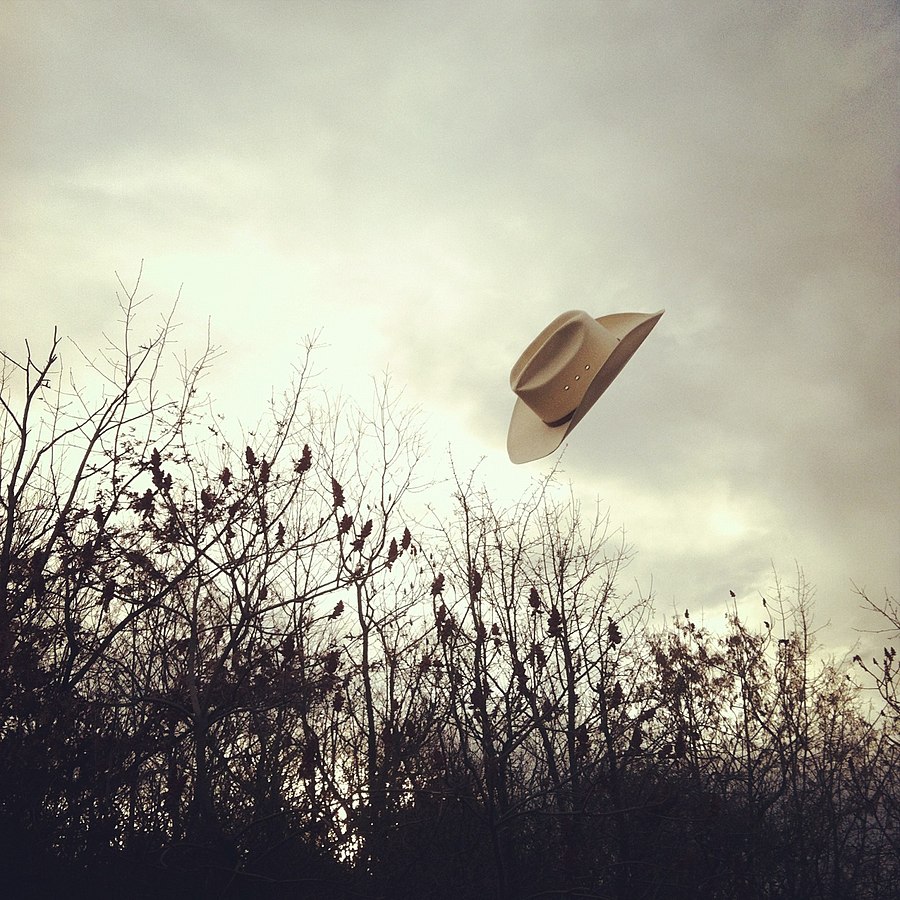
Artwork by Creative Commons.
© The Glacier 2024. All rights reserved.
 The Glacier