The Glacier
Issue Two
Winter 2023
The Thing About the Mail
The thing about the mail is that much of it’s invisible en route. You hand over your envelope or package to the carrier, and then watch it disappear, first gradually from the corners, then faster and faster until the center winks out. In this it’s so much like the problem of prayer that carriers are regarded as a subset of the priestly class, for they traffic in spectral exchanges. (To gain employment at the postal service, you must first prove that you’re a mnemonic savant, able to hold each address in memory after having seen it only once, and to recognize each item by its heft and feel in your hands.)

Sadly, however, the only mail that never achieves invisibility status is junk mail, which remains not only hyper-present but indestructible by immolation, immersion, shredding. When buried or drowned, it indefatigably rises; when placed between scissors, it becomes so slippery it prevents the blades from meeting; and when consigned to flames, it won’t even smolder. Everyone loves to watch mail reappear in the recipient’s grasp, except for the bills, of course.

*

No, the thing about the mail is that it can’t decide what story it adds up to. It used to think that it was the innocence-to-experience story, but now it wonders if it’s the interrogative/imperative story, the talismanic/oracular story, or even the epiphanic story. It ponders the troubling phenomenon of consciousness in the universe; it contemplates the question of origins. But when it sleeps, it dreams that it’s none of these stories—that it is, in fact, merely decoy mail sent out to draw off the gobblers who hunt in packs to devour unread correspondence.

*

No, the thing about the mail is that a letter sent out whole arrives in pieces over the span of a generation—a word here, a sprinkling of punctuation marks there— and must be painstakingly reassembled with no assurance of accuracy, like a symphony whose every note and rest has been packed separately in a small black lacquered box, all of the boxes hidden throughout a forest amidst the underbrush and among the branches and in the crowns and cavities of trees so that those who find them have to string them on the staff according to their collective best guess.

*

No, the thing about the mail is that separately and in small bundles, each item is peaceable, inert, but at a certain level of accumulation they begin to fight and cannibalize each other.

Sometimes, as one would expect, it’s the ponderous package or the oversize envelope bulky with tax documents that proves to be the alpha, but just as often, it’s the simple photocopied flyer-with-a-stamp or the reticent little “save the date” notice that comes out intact, while all that’s left of the rest is a bit of fine gray powder—a mixture of white space and ink—that swiftly dissipates into the atmosphere.

Most postal workers shudder at the forbidden practice of baiting and tormenting individual mail items to intensify their aggression, but there are always those few who abuse their official trust and set up fight rings, placing bets on which items will attain dominance.

*

No, the thing about the mail is that it suffers air, it suffers light, it suffers touch by human hands and the walls of various conduits and receptacles. Mail is made of thought and feeling, cognition and sensation, and thus feels at home only inside the cranial cavity, the chambered heart; none of these things belongs in the external world, so what mail desires is for time itself to slip its gears and run in reverse,  the signature disappearing first as the letters of the signer’s name evaporate, then, with its varying degrees of nearness or distance, the complimentary close—eternally yours, hugs and kisses, love, cordially, sincerely, all best, regards—or the admonition—be good, stay safe, keep the faith, write soon, send money please—then the body of the missive, bottom to top—gossip, chitchat, argument, declaration, apology, explanation, invitation, and at last, the salutation as the paper goes blank, while within its author, the communicative impulse begins to dissolve until all that’s left is grievance, remorse, or desire in a pure pre-linguistic state.

*

Yes, the thing about the mail is that it’s with us no longer. Walking down a street where any mailboxes still stand, children tug on their parents’ coats and ask, “What are those funny little houses on sticks?” Instead, we now live among multitudes of tiny, floating sparks that deliver information directly to the brain by entering through our eyes. Though we mostly approve of our transition from the physicality of letters to this evanescent, ubiquitous twinkling, we don’t leave the mail unmemorialized; everyone takes their designated turn to don the ceremonial mourning robes of painstakingly stitched white paper and trudge the old postal routes chanting the zip codes, each number a distinct sacred tone. When a mourner goes by, you must pause, incline your head, and perform the ritual gestures of indirection to honor the Two Lost Things, absence and darkness. Then you may proceed again, wending your way between the sparks.
Going Under
We sleep when our skin becomes saturated with night; we sleep to escape from noonday glare–flat light, ghost light, the hour when spirits walk, as the ancients believed. We sleep because we’re exhausted by the seventy-one dimensions of sky bearing down on us, inexorable as stone as we wake-walk through a world with rogue waves; slime molds; chocolate ganache cakes; fragrant, incrementally migrating forests; and involuntary human affliction virtuosos invited to locate their minutest sensations on meticulous taxonomies of pain.


We sleep because we’ve run out of thoughts or we have too many thoughts or the spaces between the thoughts have grown thick with a soft gray substance that’s neither fur nor mold but like them in texture, exuding a subtle soporific fog. Some of us sleep as punishment, sent supperless to our severe and narrow beds. Others sleep for indulgence, arms outflung, luxurious expanse unfurling. We sleep incidentally, we sleep incrementally. We sleep exuding dreams like the voluptuous ink clouds of an octopus garden. We sleep on our feet like horses; curled over the steering wheels of parked cars; and sometimes, terrifyingly, as we drive. We dote on sleep as if it’s a delicate only child that we’d ply with bonbons, bedeck with pearls, and daub with tinctures of crushed diamonds plucked from the coronation tiaras of popes and queens. We bargain with sleep, we chastise it, we compete with each other over its supreme inadequacies–”I had the worst night!” “No, mine was far more wretched!” We stalk our sleep, dragging our paltry nets and snares behind us as we crawl over miles of crushed glass and barbed wire toward where it was last sighted. We sleep in layers, we sleep in stages; we sleep through sequences of false awakenings as though tumbling down the stairs of sleep through sub-basement after sub-basement in interminable descent. We sleep through the first, second, third, and fourth watches of the night and in the intervals between them that are made not of minutes but of slippage and unlikeness. We could say that sleep is a waste of time if we knew what time was. We could say that time is a waste of sleep, but while dreaming, we’re everyone we’ve ever been, and we’re the death-self we like to pretend is a stranger though it’s been our nearest companion from the very first breath. We sleep incandescently, we sleep phosphorescently. In sleep, the body breathes as houses do no matter how many caked-up layers of caulk and sealant the owners have applied, slow seepage of breath, voices, memories, aromas, and soul-glow. Who lived in your house before you, what dream-residue brushes your face like spider-silk as you cross the threshold between rooms? And long before there were houses, the land itself slept during great freezes when the fish dreamt in suspension, torpid under layers of ice, and during the aftermaths of floods when everything was tranced and still. That was the sleep of history before the twinkle of electronic devices in every room like domestic constellations. Now sleep texting is on the rise since everyone beds down near or even with their phones as though connected by an unseen umbilical cord, so in the morning, pixels reveal the heart’s occult detritus like broken shells and fish bones exposed by a receding tide: complaints, declamations, confessions, personal manifestos, breakups, propositions and proposals–yes, the culture of sleep is changing– there’s sleep-shopping, too, a retail extravaganza in the emporium of night. And that’s only the beginning; soon, all vehicles will be autonomous, sentient metal pods bearing slumberers chipping away at their sleep debt’s compound interest  so that dreaming will be associated with motion itself and the very act of getting into a vehicle will cause us to nod off–we’ll wake up just in time to stumble into work, though there’s something about sleep that will never be commodified, never turned into capital because the real reason we sleep is for relief from the sensation of being always, repeatedly, and continually ourselves, ourselves when we wake up in the morning, ourselves when the clock strikes midnight, and in between, as we pause to check during micro-moments of awareness during the day, still ourselves–who would have thought it?
CLAIRE BATEMAN is the author of nine poetry collections, most recently, WONDERS OF THE INVISIBLE WORLD (42 Miles Press). Her hybrid collection, THE PILLOW MUSEUM is forthcoming from FC2 in January 2025. She has received two Pushcart awards and a NEA grant, and is the two-time winner of the New Millennium Award in Poetry.
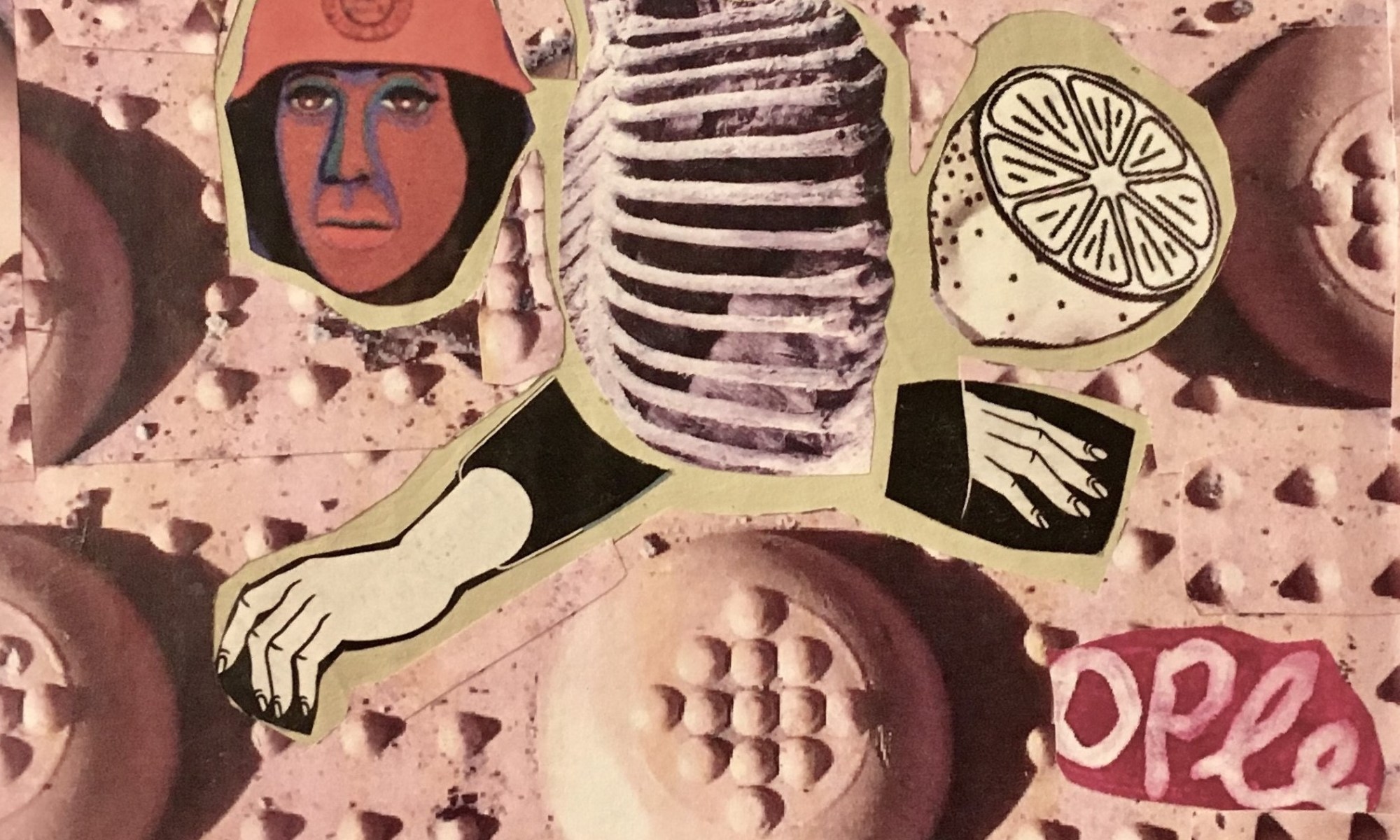
Artwork by David Dodd Lee.
© The Glacier 2023. All rights reserved.
 The Glacier